Can an Old Pool Surround Be Resurfaced Without Removing the Whole Existing Surface?
Wednesday, 21 October 2026
If your pool surround is looking dated or becoming uneven, replacing the entire area may...
Read More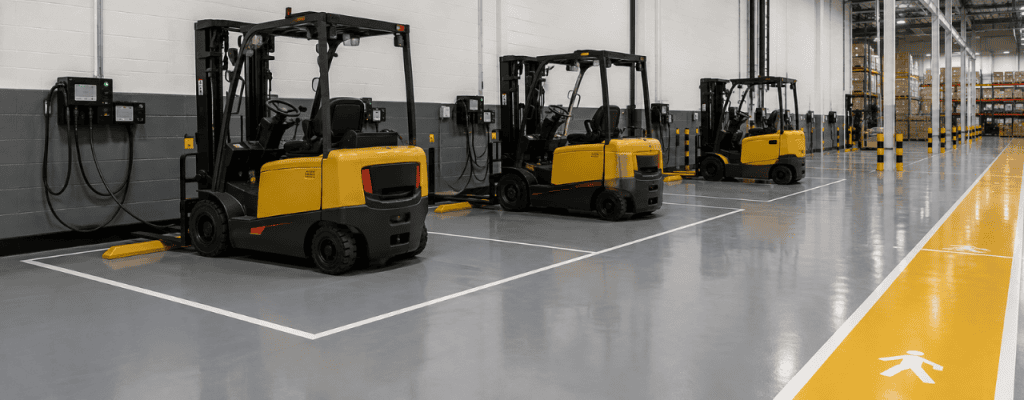
Battery charging bays concentrate several operational demands into a relatively small area. Forklifts cross the same routes; drivers turn in fixed positions and charging equipment creates permanent load points. Depending on the battery technology used, the floor may also be exposed to electrolyte spills, cleaning products and other contaminants.
Commercial epoxy flooring can provide a seamless, hard-wearing and easy-to-clean finish for suitable charging areas. However, the system still needs to match the condition of the concrete, expected chemical exposure, vehicle movements and required return-to-service window.
At FLEX, we review the subfloor, charging process, traffic routes and surrounding operations before recommending a flooring build-up. Planning a new battery charging bay or refurbishing an existing area? Ask us to inspect the site before the system, line marking and installation programme are agreed.
A charging bay is not simply another section of a warehouse. Vehicles repeatedly enter, stop, turn and leave through the same routes. Chargers, battery stands and handling equipment may also remain in fixed positions for long periods.
Wear commonly becomes concentrated around:
A floor can still appear sound across the open bay while beginning to fail around these pressure points. Worn coatings, damaged joints and exposed concrete make the area harder to clean and can allow contamination to penetrate the underlying slab.
The battery system also affects the risk profile. Lead-acid batteries can introduce electrolyte exposure, while lithium-ion charging areas bring different operational and fire-management considerations. These wider controls sit outside the flooring specification, but the floor still needs to support the way the charging area is operated and maintained.
The flooring system needs to do more than improve the appearance of the area. It should respond to the site’s actual chemical, traffic and cleaning demands.
Chemical resistance varies between products. Describing a floor as chemical resistant does not confirm that it can withstand every acid, electrolyte, cleaning agent or industrial contaminant.
Before commercial epoxy flooring is selected, the installer needs to understand:
The relevant safety data sheets and resin manufacturer’s chemical-resistance information should form part of the assessment.
Contact time matters as well. A coating that tolerates brief contact with a diluted substance may not withstand a concentrated spill left on the surface for several hours. The flooring should support the site’s spill-response procedure rather than replace it.
Charging areas can become contaminated by rainwater from vehicle tyres, cleaning solution, dust or electrolyte. The required finish should therefore consider both slip risk and cleanability.
A heavily textured finish may provide additional grip, but it can also retain dirt and take longer to clean around chargers and battery stands. A smoother finish may be easier to maintain but unsuitable where regular wet contamination cannot be prevented.
The final texture should reflect:
Commercial epoxy flooring can be specified with an aggregate finish where additional texture is required, but the correct balance should be agreed before installation.
Forklifts do not apply an even load across the entire charging area. Braking, turning and stationary steering place more pressure on particular points.
The flooring assessment should account for:
A thin coating may suit a sound slab in a moderately used bay. A deeper commercial epoxy flooring system may be more appropriate where the surface is damaged, or the operating demands are higher.
FLEX also installs resin systems for wider factory and warehouse flooring projects, where repeated forklift routes and operational loading influence the specification.
The site review should influence the preparation, quotation and installation programme.
Commercial epoxy flooring will only perform as well as the surface beneath it. Dust, grease, laitance, old coatings, weak concrete and moisture can all affect adhesion.
Preparation may include:
Surface preparation forms part of the flooring system. Applying a new coating over contamination or unstable concrete may improve the appearance temporarily, but it does not address the cause of the existing failure.
Moisture within the slab can affect installation and curing. Standing liquid can also create operational problems once the bay returns to use.
Existing falls, channels and drainage points should be checked before the surface is coated. A seamless finish will not correct a floor that directs liquid towards a charger, doorway, electrical installation or live traffic route.
Drainage decisions also need to follow the facility’s environmental and spill-control procedures. Battery electrolyte or contaminated cleaning water should not be directed into drainage without the appropriate assessment.
Flooring systems often begin to show wear around joints, drains, kerbs and transitions into adjoining areas.
Active movement joints should not simply be coated over. Their location and condition need to be included in the flooring design. Weak edges around channels, doorways and equipment bases may require repairs before installation begins.
These details can add time to the programme but resolving them during preparation is usually more practical than repairing the finished floor later.
Line marking can help clarify how vehicles and pedestrians should move through the charging area.
The layout may identify:
The markings should follow the site’s operational plan. Charger positions, vehicle dimensions and turning circles need confirming before the final layout is agreed.
Colour alone does not create a safe traffic system. Physical segregation, signage, lighting, driver procedures and staff training may still be required. However, durable floor markings can support clearer pedestrian and vehicle access when they form part of the wider traffic-management plan.
Phased installation may be possible where the facility has enough space to create a temporary charging location or isolate sections of the bay.
A phased programme may involve:
The programme still needs to allow for each coating stage and the manufacturer’s curing requirements. A floor should not return to forklift use simply because it feels dry.
At FLEX, we confirm the preparation, installation stages and realistic return-to-service window before work starts.
Some systems can be specified for exposure to particular acids and electrolytes, but resistance varies by product, concentration, temperature and contact time.
The installer should review the relevant substances and technical information before confirming suitability. Spills still need to be contained and cleaned in line with the site’s procedures.
It can provide a suitable working surface where the system matches the traffic, cleaning and operational requirements.
The floor does not control the electrical, fire or thermal risks associated with lithium-ion batteries. Those risks require a separate assessment and appropriate charging, monitoring and emergency procedures.
Yes. Aggregate can be incorporated into commercial epoxy flooring where additional texture is required.
The finish should balance slip resistance with the need to clean the area effectively. The right texture depends on the likely contamination, working conditions and cleaning method.
Yes. Charging positions, pedestrian routes, vehicle lanes and exclusion areas can be included in the flooring programme.
The layout should be confirmed before installation so the markings correspond with the final charger and equipment positions.
The programme depends on the slab condition, repairs, flooring system, temperature, coating stages, curing requirements and line-marking detail.
We confirm a project-specific programme rather than applying one standard timeframe to every site.
A charging bay floor needs to reflect the battery technology, chemical exposure, forklift movements and cleaning procedures used at the facility. The condition of the concrete, drainage detail and time available for installation also affect which build-up is appropriate.
Contact FLEX to discuss the site or request a tailored quotation. We will assess how the area operates before recommending suitable commercial epoxy flooring for the charging bay and agreeing the preparation, finish, demarcation and installation programme.
Experts in epoxy and polyurethane flooring systems
If your pool surround is looking dated or becoming uneven, replacing the entire area may...
Read More