Can an Old Pool Surround Be Resurfaced Without Removing the Whole Existing Surface?
Wednesday, 21 October 2026
If your pool surround is looking dated or becoming uneven, replacing the entire area may...
Read More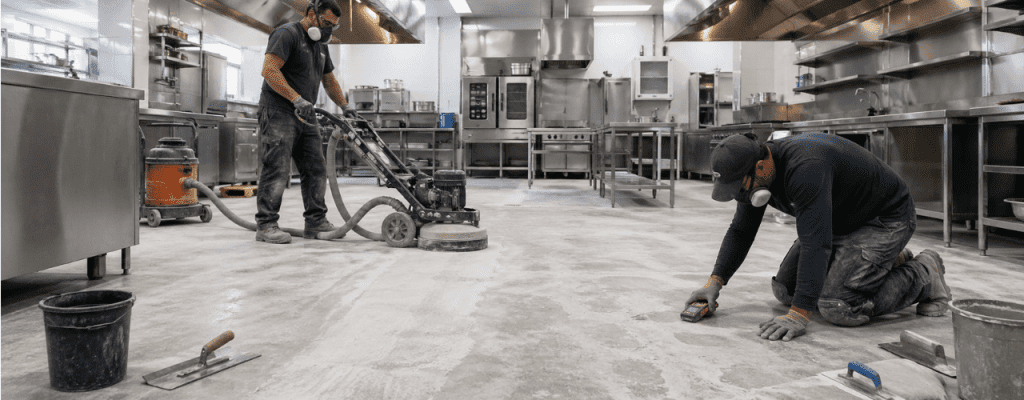
Poor preparation is the primary cause of flooring failure in commercial environments. Businesses often lose revenue when defective surfaces require unexpected replacement. FLEX has spent over fifteen years resolving these challenges as specialist epoxy kitchen floor installers in Kent. Our installation specialists understand that a professional resin outcome begins with the substrate. We install seamless resin solutions designed for heavy-duty safety and low maintenance in demanding spaces. This guide outlines the specific technical epoxy kitchen floor preparation before installation necessary to secure adhesion and long-term durability.
Epoxy kitchen floors typically peel because the resin failed to form a mechanical bond with the concrete substrate. This usually happens when the surface is too smooth, contaminated with grease, or contains high moisture levels. Without a deep “anchor” into the concrete pores, the resin sits on the surface rather than becoming part of the slab.
Industrial facilities rely on robust surfacing to maintain safe daily operations. If the subfloor has hidden dampness or structural weakness, the topcoat eventually detaches under the stress of heavy foot traffic and thermal shocks. Our installers treat the substrate evaluation as the most critical phase for every commercial epoxy kitchen floor in Kent, ensuring the finished floor provides years of reliable service.
The ideal base for epoxy kitchen flooring is a structurally sound, dry concrete slab that has been mechanically profiled. While resin can be applied over other materials, the most durable installations require a concrete base with a minimum tensile strength of 1.5 N/mm². If the base is deteriorating, we often recommend a high-build screed to reinforce the surface before the final coating is applied.
We test for moisture using digital hygrometers to measure the relative humidity (RH) within the concrete slab. If the moisture content is above 75% RH, a standard epoxy will not bond. In these cases, we must install a liquid damp-proof membrane (DPM) or a moisture-tolerant primer to prevent hydrostatic pressure from blistering the final finish.
Peeling or cracked floors are an immediate hygiene violation during EHO (Environmental Health Officer) inspections. As leading epoxy kitchen flooring contractors in Kent, we ensure your facility remains compliant. Book a professional floor audit with Flex Flooring to avoid the risk of heavy fines.
When preparing a commercial kitchen for an epoxy floor, the concrete must be professionally degreased using industrial scrubbing equipment and citrus-based degreasing agents. This process extracts fats, oils, and organic residues that would otherwise act as a “bond-breaker,” preventing the polyurethane and synthetic resin from penetrating the concrete.
Commercial kitchens accumulate layers of grease over years of operation. Our specialists focus on pulling these contaminants out of the porous concrete matrix. This precision delivers the hygiene and slip resistance required by health and safety regulations.
The primary epoxy kitchen floor installation requirements include a dust-free environment, a dry substrate, and a mechanical profile created through diamond grinding or shot blasting. These techniques remove “laitance” which is the weak, powdery top layer of concrete and open the pores to create a rough texture similar to 60-grit sandpaper.
FLEX selects the machinery based on the project requirements. Diamond grinding is ideal for thin-film coatings, while shot blasting provides the aggressive profile needed for thick, heavy-duty polyurethane screeds. Our installation team ensure the area is clear of debris and structural defects before the first layer of resin is poured.
Concrete cracks must always be repaired before the resin application. If left untreated, liquid epoxy flows into the voids, leaving a “sinkhole” in your finished floor. Our installers “chase out” existing cracks with a diamond blade, clear the debris, and fill them with a high-strength, rapid-curing resin mortar.
Static cracks that are not stabilised will eventually “reflect” through the final finish, compromising both the appearance and the waterproof properties of the floor. Once the mortar cures, we grind these sections flush to ensure the floor remains practical and visually cohesive for heavy machinery and trolleys.
Maximum durability is achieved by combining mechanical profiling, moisture management, and correct primer selection. When these technical steps are followed, the resin withstands the daily impacts of dropped pans, hot oil spills, and aggressive chemical cleaning without failing.
A commercial catering environment has unique physical demands. By ensuring the foundation is prepped, we deliver an industrial finish designed to survive these conditions. We provide floors that are hygienic and simple to clean, helping restaurants maintain operational efficiency without frequent maintenance downtime.
During a site survey, our epoxy kitchen floor preparation Kent specialists conduct pull-off testing to verify the tensile strength of the concrete. We also check the gradient for commercial drainage and look for signs of chemical contamination. Identifying these subfloor complications early is the only way to guarantee project success.
We validate structural soundness and test how the slab handles the weight of your equipment. Our focus is on ensuring the modern aesthetic of your floor lasts as long as the building itself.
Acid etching is inconsistent and introduces unwanted moisture into the slab. Mechanical grinding is a dry, dust-controlled process that provides a uniform profile, ensuring the strongest possible chemical bond for your investment.
In the catering industry, finding a gap for maintenance is difficult. Planned shutdowns are the most efficient time to upgrade your flooring without impacting revenue. Ensure your facility is prepped and ready for its next health inspection. Contact Flex Flooring today to secure your technical site survey and installation date.
Experts in epoxy and polyurethane flooring systems
If your pool surround is looking dated or becoming uneven, replacing the entire area may...
Read More