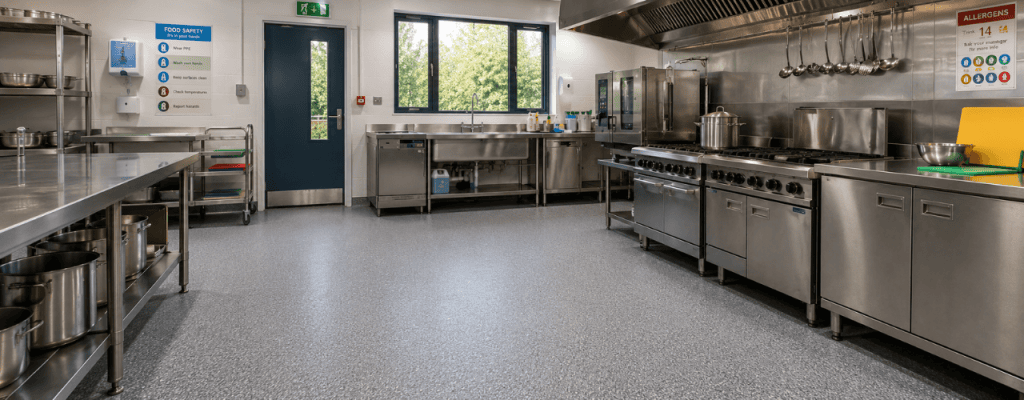
What Should Schools Check Before Installing Resin Kitchen Flooring?
Wednesday, 30 September 2026
A school kitchen works within narrow service windows. Breakfast preparation may begin early; lunch must...
Read More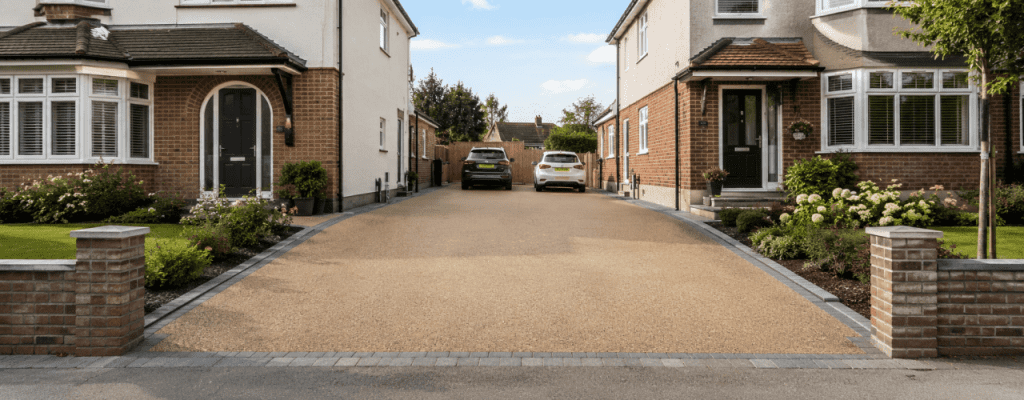
Shared residential access roads endure daily wear far exceeding the capacity of a standard domestic driveway. Multiple households relying on a single entry route cause traditional tarmac or concrete surfaces to degrade under constant turning and heavy braking. Potholes eventually form. These structural failures lead to surface water runoff issues and complex drainage disputes among neighbours. Residents’ associations require a durable road surface capable of handling continuous traffic without frequent patching.
Selecting an inadequate surface for a shared private road leads to immediate financial and social friction. Standard tarmac or loose gravel struggles to withstand the shear forces generated when multiple vehicles turn in the same tight radius daily. This results in rutting alongside surface “ravelling,” where the stones break loose and migrate onto public highways.
Inadequate specifications deplete communal maintenance funds through constant temporary repairs. Potholes in a shared environment represent a significant liability for the residents’ association. Poorly specified surfaces lacking permeability lead to standing water that damages the foundations of adjacent properties. Investing in high-performance resin bound driveways prevents these recurring costs. It ensures the access route remains a shared asset rather than a collective liability.
Specifying a resin bound driveway for shared driveways manages the demands of private roads when installed over a load-bearing, commercial-grade sub-base. Specialist installers apply a specific resin thickness using appropriate aggregate sizes. This combination ensures resin bound driveways withstand the constant rotational pressure of vehicles turning their tyres while stationary.
Property developers often express concern regarding the longevity of decorative paving under communal use. For these high-traffic environments, we work exclusively with Vuba, the UK’s leading manufacturer of high-performance resin systems. Every FLEX installation utilizing the full system, including VubaMac and SRM (Structural Reinforcement Mesh), comes with a 5-year no-crack guarantee. Increasing the trowelled thickness and selecting the right stone size grants resin bound driveways the structural integrity required for delivery vehicles and refuse lorries.
The durability of a resin bound driveway for access roads depends entirely on the stability of the hidden layers beneath the stone. A strong sub-base prevents the rutting and surface failure typically seen under repeated heavy vehicle loads.
Pouring premium resin components onto a weak or shifting foundation guarantees the road will buckle under the weight of commercial traffic. FLEX applies civil engineering principles to every shared resin bound driveway Kent project to verify ground density before laying the final finish.
“We prefer a sub base of compacted MOT type 3. Onto this, we recommend installing VubaMac structural base build up. This not only enhances the strength of the entire system, but is permeable too. It can also be installed at different depths depending on the needs of the installation. The final element is the Vuba SRM, which strengthens the surface even more.” Tom Cort, Operations Manager. FLEX Surfaces and Floors
Many local councils now demand a permeable resin bound driveway for shared access to manage rainwater and prevent surface flooding. Our resin bound stone system, with VubaMac is fully SuDS compliant, allowing water to permeate through the surface at rates far exceeding typical UK rainfall. These access roads reduce the burden on public sewers by allowing groundwater to dissipate organically into the soil.
Flooding on a private road causes serious friction between neighbouring households. Standing water obscures deep potholes. It also forms dangerous icy patches during winter months. Traditional tarmac forces rainwater to run off the edges, necessitating costly earthworks or deep drainage trenches to manage the flow legally. Installing a permeable resin bound driveway Kent allows rainwater to drain straight through the aggregate. This protects adjacent properties from water damage.
Large access roads require specific chemical binders to maintain their visual appeal over several decades. Professional resin bound driveway installers Kent exclusively use clear, UV-stable aliphatic polyurethane binders for these projects. These resins resist ultraviolet light degradation. This ensures resin bound driveways do not yellow, fade, or become brittle over time.
The appearance of a long access road sets the aesthetic tone for the entire residential development. A yellowing finish looks neglected. It frustrates homeowners who have invested in a high-quality environment. Inferior aromatic resins degrade structurally under direct sunlight. Specifying UV-stable aliphatic resins for all shared surfaces guarantees resin bound driveways retain their original colour and optical clarity well into the future.
A joint-free resin surface offers exceptional grip levels that drastically reduce the risk of skidding. We can integrate a polymer bead into the mix to further increase slip resistance without affecting the aesthetic. This completely flat construction removes the raised edges and paving joints that pose tripping hazards for pedestrians.
Surface friction remains a baseline requirement for residents’ associations managing communal spaces. Loose gravel frequently scatters onto public footpaths, creating poor braking conditions. Block paving often sinks under high traffic to leave deep ruts. Poured resin bound driveways eliminate these specific ground hazards to keep the route flat and safe for every resident.
Upgrading a communal road is a significant decision for any residents’ committee or developer. We provide free quotations and site visits to assess your existing sub-base and layout. Our experts will provide a detailed breakdown taking into account m² size, layout complexity, and the specific material specification required for your traffic load.
Contact FLEX today to evaluate the requirements for your durable resin bound driveway for multiple properties.
When installed over a commercial-grade base like EcoGrid or VubaMac, heavy use resin bound driveway systems routinely last well over fifteen years. The core structure remains intact despite relentless daily traffic from multiple households and heavy delivery vehicles. Most installations are exceptionally quick to complete, and the surface is typically ready to use again within just 24 hours.
These tough surfaces require remarkably low maintenance. Residents simply need to coordinate an annual low-pressure wash and routine leaf sweeping. These actions keep the drainage channels of resin bound driveways completely open and keep the stone colours looking sharp.
Complex shared road projects require specialist equipment and large, trained crews to maintain a “wet edge” during the hand or power trowelling process. Professional resin bound driveway installation Kent teams understand the strict engineering demands of heavy vehicle loads. Working with experts ensures the installation is efficient and the access road is reopened to traffic within the standard 24-hour window.
Experts in epoxy and polyurethane flooring systems
A school kitchen works within narrow service windows. Breakfast preparation may begin early; lunch must...
Read More